
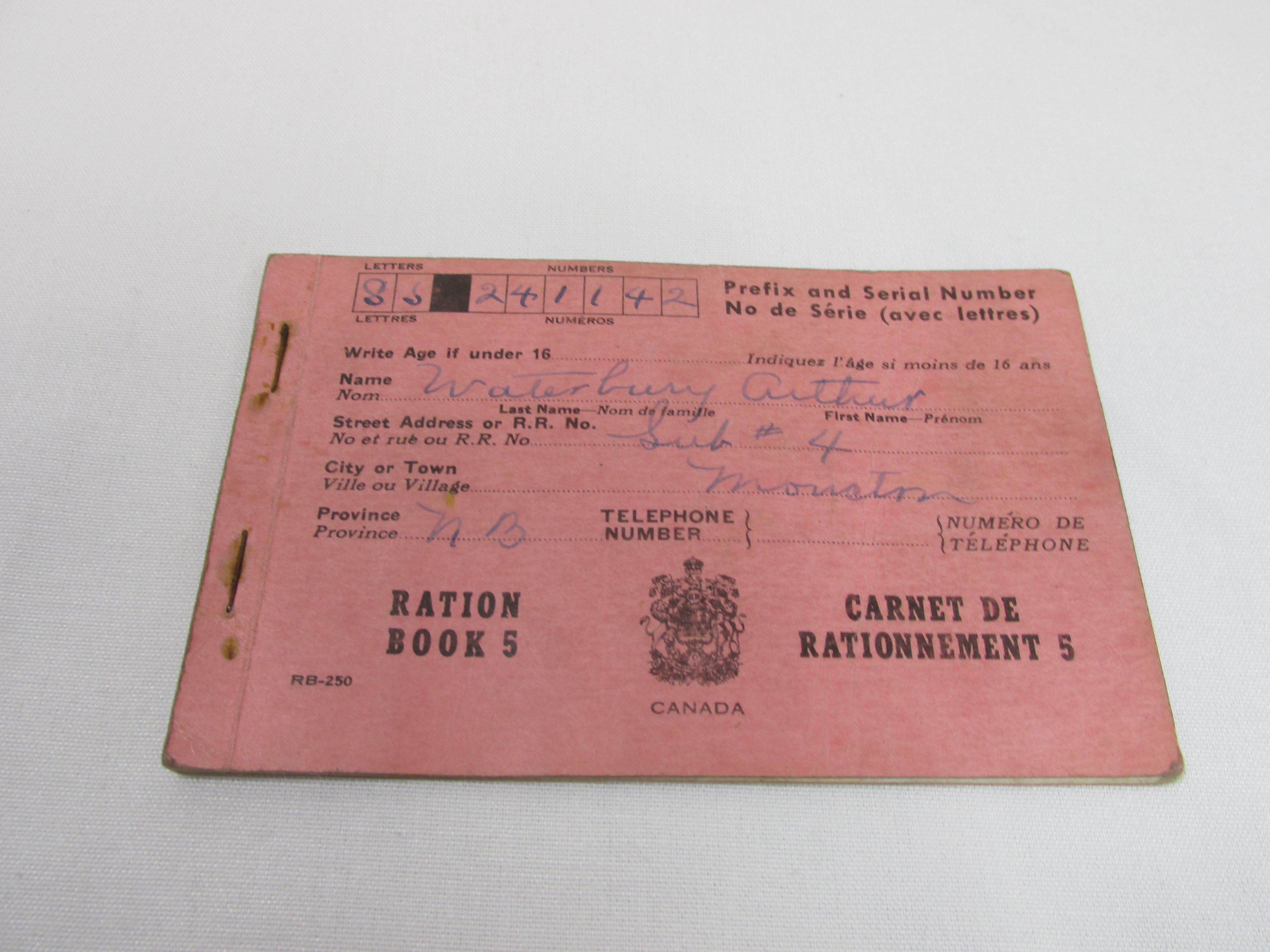
Book
Lutz Moutain Heritage Museum
Tous droits réservés.
| Nom de l'objet : | Book |
|---|---|
| Artiste ou artisan : | Government of Canada |
| Type de l'objet : | Ration |
| Catégorie de l'objet : | Category 8: Communication Objects |
| Matériaux : | Paper Metal |
| Technique de fabrication : | Printed Handwritten |
| Numéro d'accession : | A2018.15.42 |
| Pays d'origine : | Canada |
| Province d'utilisation : | New Brunswick |
| Pays d'utilisation : | Canada |
| Date de début de production : | 1942-01-01 |
| Date de fin de production : | 1947-12-31 |
| Description : | Pink soft cover book contains coupons issued by the wartime prices and trade board. Bound with two staples. |
| Commentaires : | Shortly after the commencement of World War 2, rationing was introduced in Canada (on January 24, 1942), to limit the use of imported and domestic food and to free up supplies for the military and their allies. The government introduced rationing to ensure that what was needed to go to the war effort, was being provided to the military. The first thing that began to be rationed in Canada was gasoline. However, it then spread to sugar, tea, coffee, butter, and meat. Additionally, household appliances, automobile tires, and even clothing had to be rationed so that there was enough of these materials for companies manufacturing items for wartime needs. Because of this, many Canadians offset the impact of rationing by growing their own foods. Generally speaking, rationing was supported by Canadians. However, that did not mean that there was not an illegal market for some goods like gas and tires. This ration book belonged to Arthur Wyse Waterbury from Moncton, NB. Arthur Wyse Waterbury (1900-1980), son of John P. Waterbury and Ada Barnes, was the husband of Edith Lillian Trites (1904-1984). They were married on August 5, 1936. |
| Fonctions : | Ration books would be provided to almost every adult and child in Canada, except for military personnel. These books would be taken with you when you went to the store to purchase food. To ensure that each and everyone received their fair share of rationed food, specific stamps were required be provided to the cashier in order to obtain foods such as sugar, tea, coffee, butter, and meat. Without the specific stamps required for each rationed food, you would be unable to purchase that item from the store. |
| Longueur : | 13.6 cm |
| Largeur : | 8.6 cm |
| Établissement : | Lutz Moutain Heritage Museum |
| Ville de l'établissement : | Moncton |
| Province de l'établissement : | New Brunswick |