
Postcard
Carte postale
Benares Historic House
All rights reserved.
| Object Name: | Postcard Carte postale |
|---|---|
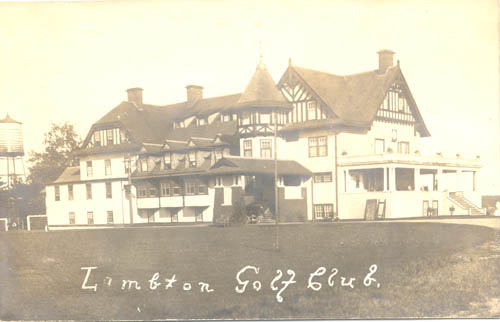
| Title: | Lambton Golf Club Lambton Golf Club |
| Classification: | Communication Artifacts, Documentary Artifact, Artefacts de communication, Artefacts documentaires |
| Material: | paper papier |
| Accession Number: | 1998.1.106 i |
| Earliest Production Date: | 1900 |
| Latest Production Date: | 1910 |
| Description: | A blank postcard, depicting a black and white photograph of the club house for the Lambton Golf Club. A water tower is depicted to the left. The building is large, with a grassy terrace in front.; Carte postale vierge avec une photo en noir et blanc du pavillon du club de golf de Lambton. Un château d'eau figure au le coin gauche. L'édifice est grand avec du gazon en terrasse devant. |
| History of Use: | The Lambton Golf Course, located in Toronto along the Humber River, is just south of Eglinton Avenue. Now the Lambton Golf and Country Club, it is a private course situated mostly on what used to be known as the John Scarlett homestead. The club and course was spearheaded by Albert Austen, of Spadina House fame, and George Lyon, an 8 time Canadian amateur golf champion and gold medallist at the 1904 Olympics. The club opened in June 1903. At the time of the printing of this postcard, most members travelled by train to the golf course, which was far beyond city limits. See: City of Toronto, Heritage Columns, vol. 1, no. 2, Fall 2001. The game of golf in Canada originated with the increase of Scottish immigrants to Canada during the nineteenth century. By 1873, the formation of the Royal Montreal Golf Club solidified the birthplace of organized golf in Canada. With the formation of several clubs in Ontario (at Toronto, Brantford, Kingston and Niagara) the first inter-provincial matches were held beginning in 1882 between Quebec and Ontario. Several factors facilitated the increase in participation such as an increase in demand for outdoor activities by an urban population; a shortened work week; and improvements in transportation systems. A tremendous number of women entered the sport in the 1890s as restrictions of the Victorian era woman began to disappear. See: Karen Hewson, "An Early History of Golf in Canada" the Canadian Golf Hall of Fame and Museum. Postcards are quite collectible and have appraisal values based on specifics of the postcards. Information to note about a postcard is its publishing information, copyright dates, an artist's signature, a series number, and/or subject matter. Greeting postcards are especially worth noting, for specific holidays such as Valentine's Day, Hallowe'en, etc. For further research on the value of postcards, see J. L. Mashburn. _The Postcard Price Guide: A Comprehensive Reference_ Third Edition. Enka, North Carolina: Colonial House, 1997. This item was donated by Geoffrey Harris Sayers, who was born 23 April 1907 and died 25 November 1997. A retired businessman, he was the first child of Beverly and Annie Sayers (née Harris). A member of the Canadian Armed Forces, he was appointed 2nd Lieutenant 14 June 1938. Two years later, he was appointed Lieutenant. As of 21 April 1941, he was appointed the rank of Temporary Captain, and was recommended for appointment to the Lorne Scots (P. D. and H. Regiment) based out of Brampton. According to his military file, Captain Geoffrey Sayers served with the Canadian Forces from 21 April 1941 until 11 October 1945, when he was honourably discharged. From 17 June 1941 until 13 March 1945, he also served with the British Forces (he had British citizenship). He received the Canadian Volunteer Service Medal and Clasp 1939-45. Geoffrey Sayers and his sisters, Dora Sayers Caro, and Barbara Sayers Larson donated Benares Historic House to the Ontario Heritage Foundation in 1969. It has operated as a museum under the City of Mississauga since 1995 and was officially transferred to Mississauga in 2000. Geoffrey Sayers and his wife Kathleen (née Colloten) occupied Benares from 1969 until 1981. During that time, they acted as care takers of the estate on behalf Ontario Heritage Foundation. They kept a small display of artifacts in the kitchen, and opened up the house once a year to the public. He also maintained the Benares financial affairs in 1932 for Naomi (Na) and Mary, who were unable to do so themselves.; Le terrain de golf de Lambton, situé à Toronto le long de la rivière Humber, est au sud de l'avenue Eglinton. Connu maintenant comme le C lub de golf et de loisir de Lambton, le terrain privé est situé sur l'ancienne propriété de John Scarlett. Albert Austen, célébrité de la maison Spadina, démarre le club et le terrain, avec George Lyon, qui a gagné huit fois le tournoi canadien amateur et la médaille d'or aux Jeux olympiques de 1904. Le club ouvre les portes en juin 1903. À l'époque où cette carte postale est imprimée, la majorité des membres prenaient le train pour se rendre au terrain de golf qui était à l'extérieur des limites de la ville. Voir : City of Toronto, Heritage Columns, vol. 1, no 2, automne 2001. Le jeu de golf est introduit au Canada au cours du XIXe siècle suite à l'augmentation des immigrants originaires de l'Écosse. En 1873, la formation du club de golf royal de Montréal a solidifié le lieu de naissance du jeu organisé au Canada. La formation d'autres clubs en Ontario (à Toronto, Brantford, Kingston et Niagara) incite les premiers matchs inter-provinciaux en 1882, entre le Québec et l'Ontario. Plusieurs facteurs ont favorisé le rythme accéléré de participation au sport notament une population urbaine qui demande plus d'activités en plein air, la semaine de travail écourtée et les systèmes de transport améliorés. Quand les restrictions victoriennes disparaissent en 1890, beaucoup de femmes s'adonnent au golf. Voir : Karen Hewson, «An Early History of Golf in Canada», Canadian Golf Hall of Fame and Museum. Au début des années 1900, l'empiétement des projets de logement ont contraint deux clubs de golf de Toronto à chercher de nouveaux espaces verts. L'un des clubs devient le Club de golf de Lakeview, l'autre, le club de golf et de loisir de Mississauga, s'établit plus à l'ouest. Depuis lors, Mississauga a accueilli d'autres clubs, comme le club de golf et loisir de la Credit Valley, le club de golf de Derrydale et le club de golf de Streetsville, pour n'en nommer que quelques-uns. Voir : l'exposition sur l'histoire du golf à Mississauga par la Fondation du patrimoine de Mississauga. Les cartes postales sont très populaires chez les collectioneurs et leur valeur est calculée en fonction des caractéristiques particulières des cartes. Les choses à retenir sur une carte postale sont les données de publication, les dates de droit d'auteur, la signature de l'artiste, un numéro de série ou le sujet illustré. Les cartes de voeux des fêtes populaires sont les plus intéressantes comme celles de Noël, de Pâques et de la Saint Valentin. Pour de plus amples renseignements sur la valeur des cartes postales, voir : J.L. Mashburn The Postcard Price Guide: A Comprehensive Reference (Enka, North Carolina : Colonial House, 1997). Don de Geoffrey Harris Sayers, né le 23 avril 1907 et décédé le 25 novembre 1997. Geoffrey Sayers était un homme d'affaire à la retraite, fils aîné de Beverly et Annie Sayers (née Harris). Il était membre de Forces armées canadiennes et, le 14 juin 1938, il est nommé au grade de sous-lieutenant. Deux ans plus tard, il reçoit le grade de lieutenant. Le 21 avril 1941, il est nommé capitaine temporaire et est recommandé candidat au régiment Lorne Scots dont la base se trouve à Brampton. Selon son dossier militaire, le capitaine Geoffrey Sayers débute son service dans les Forces le 21 avril 1941 et obtient une libération honorable le 11 octobre 1945.Du 17 juin 1941 au 13 mars 1945, il sert également dans les forces armées de la Grande-Bretagne (à titre de citoyen britannique). Il reçoit la Médaille canadienne du volontaire avec agrafe (1939-1945). En 1969, Geoffrey Sayers et ses sœurs, Dora Sayers Caro et Barbara Sayers Larson ont fait le don de Benares à la fondation patrimoine d'Ontario. Depuis 1995, Benares fut dirigé comme musée sou la direction de la ville de Mississauga et en 2000, la possession de Benares fut officiellement transféré à la ville. Geoffrey Sayers et son épouse Kathleen (née Colloten) habitent à Benares de 1969 à 1981. Pendant ce temps, ils faisaient office de gardiens du domaine. Ils gardaient une petite collection d'objets historiques dans la cuisine et ouvrent les portes au public une fois par année. En 1932, Geoffrey s'occupe également des affaires financières de Benares au nom de Naomi (Na) et Mary qui ne peuvent le faire elles mêmes. |
| Length: | 9.00 |
| Width: | 14.00 |
| Unit-Linear: | cm |
| Institution: |
Benares Historic House
 Facebook-Benares Historic House  Twitter-Benares Historic House  YouTube-Benares Historic House |
| Institution City: | Mississauga |
| Institution Province: | Ontario |