
Military Records
Dossiers militaires
Benares Historic House
All rights reserved.
| Object Name: | Military Records Dossiers militaires |
|---|---|
| Classification: | Communication Artifacts, Documentary Artifact, Written Communication Artefacts de communication, Artefacts documentaires, communication écrite |
| Material: | paper papier |
| Accession Number: | 2003.2.254 v |
| Earliest Production Date: | 1945 |
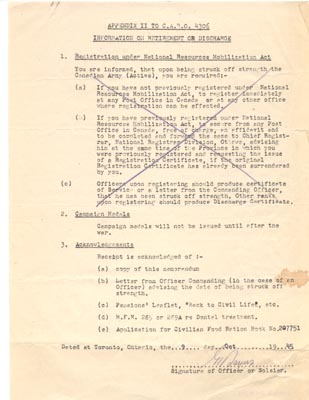
| Description: | A typewritten form on beige paper. 'Information on Retirement Discharge,' dated 9 October 1945. Information is provided on 'Registration under National Resources Mobilization Act'. This section has been crossed out with a purple pencil. Other information is regarding campaign medals, and acknowledgement of receipt of various documents. It is signed by G.H.Sayers. This form is torn on one side and has a 2.5 x 1 cm brown stain.; Formulaire dactylographié sur un papier beige. Le formulaire est intitulé «Information on Retirement Discharge» (information de libération de retraite) et est daté du 9 octobre 1945. L'information est fournie à «l'inscription sous la Loi sur la mobilisation des ressources nationales.» Cette section est rayée avec un crayon de couleur violet. D'autres renseignements traitent des médailles de campagne et accusent réception de divers documents. Le formulaire est paraphé par G.H. Sayers. Un côté du formulaire est déchiré et une tache brune mesurant 2,5 x 1 cm y figure aussi. |
| History of Use: | The Lorne Scots (Peel, Dufferin and Halton Regiments) is one of the oldest infantry regiments in Canada, tracing its history back to the 1790's when the first militia was raised in what was then the British Colony of Upper Canada. They were formed as part of a special military designed to protect the new colony. Over the years, there were various regiments formed to serve the Canadian Militia. It was not until the Fenian uprising (the Irish attempt to free Canada from British control), however, that the Canadian Authorities realized that there was a lack of training and equipment within the Militia, and a decision was made to completely reorganize it. In September of 1866, the 20th Halton Battalion of Infantry was formed. This was the beginning of the two regiments which 70 years later would become the Lorne Scots. The first Scottish connection was not made until September of 1879, when the Halton Rifles were reviewed by His Excellency the Marquis of Lorne. In 1881, permission was received to redesignate the battalion as The 20th Halton Battalion Lorne Rifles. The regiment wore tartan trews and a diced Glengarry, and a pipe band was authorized and formed. In 1929, the Peel and Dufferin Regiment became allied with the Lancashire Fusiliers. In 1936 a general reorganization of all militia units in Canada was carried out and the Peel and Dufferin Regiment and Lorne Rifles were disbanded and the Lorne Scots (Peel, Dufferin and Halton Regiments) was authorized in December. Brampton was selected as the headquarters, with companies located in Port Credit, Oakville, Georgetown, and Orangeville. (For more information concerning details of battles fought, etc, please see _A History of Peel County: To Mark Its Centenary 1867-1967_ The Corporation of the County of Peel: County of Peel, November 1967.) Geoffrey Harris Sayers, who was born 23 April 1907 and died 25 November 1997. A retired businessman, he was the first child of Beverly and Annie Sayers (née Harris). A member of the Canadian Armed Forces, he was appointed 2nd Lieutenant 14 June 1938. Two years later, he was appointed Lieutenant. As of 21 April 1941, he was appointed the rank of Temporary Captain, and was recommended for appointment to the Lorne Scots (P. D. and H. Regiment) based out of Brampton. According to his military file, Captain Geoffrey Sayers served with the Canadian Forces from 21 April 1941 until 11 October 1945, when he was honourably discharged. From 17 June 1941 until 13 March 1945, he also served with the British Forces (he had British citizenship). He received the Canadian Volunteer Service Medal and Clasp 1939-45. Geoffrey Sayers and his sisters, Dora Sayers Caro, and Barbara Sayers Larson donated Benares Historic House to the Ontario Heritage Foundation in 1969. It has operated as a museum under the City of Mississauga since 1995 and was officially transferred to Mississauga in 2000. Geoffrey Sayers and his wife Kathleen (née Colloten) occupied Benares from 1969 until 1981. During that time, they acted as care takers of the estate on behalf Ontario Heritage Foundation.They kept a small display of artifacts in the kitchen, and opened up the house once a year to the public. He also maintained the Benares financial affairs in 1932 for Naomi (Na) and Mary, who were unable to do so themselves. Items donated by Barbara Sayers Larson. Barbara Larson is the daughter of Annie Harris (1882-1986) and Beverly Sayers (1882-1976) and granddaughter of Arthur (1843-1932) and Mary (1859-1954) Harris. Barbara was born January 27, 1920 and was the youngest of three children. Barbara and her siblings, Geoffrey Sayers (1907-1997) and Dora Sayers Caro (1915-) donated Benares to the Ontario Heritage Foundation in 1969 after inheriting it from their aunt, Naomi Harris (1883-1968). Many of the items donated by Barbara originally belonged to her mother or Aunt Naomi and came from Benares. Barbara lived in the log cabin originally given to her parents by her grandparents at 1723 Birchwood Drive. Barbara still maintains a close tie with Benares and currently lives with in Kelowna, British Columbia, with her daughter.; Les Lorne Scots (régiments de Peel, Dufferin et Halton) est l'un des plus anciens régiments d'infanterie au Canada. Les origines du régiment remontent à 1790 lors de la formation de la première milice dans ce qui était, à l'époque, la colonie britannique du Haut Canada. Le régiment faisait partie d'un système militaire formé pour protéger la nouvelle colonie. Au fil des ans, plusieurs régiments ont été formés pour servir de milice canadienne. Ce n'est qu'après l'insurrection des Fenians (la tentative irlandaise de libérer le Canada du pouvoir britannique) que les autorités canadiennes se sont rendues compte que la milice manquait d'entraînement et d'équipement. On a alors décidé de la réorganiser de fond en comble. En septembre 1866, le XXe bataillon de la région de Halton est fondé. C'était le début de la formation de deux régiments qui, soixante-dix ans plus tard, deviennent les Lorne Scots. Le premier lien à l'Écosse ne se fait pas avant septembre 1879 lorsque Son Excellence, le marquis de Lorne passe les Halton Rifles en revue. En 1881, on accorde la permission de désigner le bataillon comme le 20th Halton Bataillon Lorne Rifles. Le régiment portait des pantalons et chapeaux écossais. On a également autorisé la formation d'un corps de cornemuses. En 1929, les régiments de la région de Peel et de Dufferin forment une alliance avec les Lancashire Fusiliers. En 1936, il y a eu une réorganisation générale de toutes les milices au Canada. Lors de la réorganisation, les régiments de Peel et de Dufferin ainsi que les Lorne Rifles ont été dissous. En décembre, les Lorne Scots (les régiments de Peel, Dufferin et Halton) est autorisé. Le quartier général s'établit à Brampton. Des compagnies de la milice sont installées à Port Credit, Oakville, Georgetown et Orangeville. (Pour plus de renseignements sur les détails de batailles, etc., voir A History of Peel County: To Mark Its Centenary 1867-1967 The Corporation of the County of Peel: County of Peel, November 1967.) Geoffrey Harris Sayers, né le 23 avril 1907 et décédé le 25 novembre 1997. Geoffrey Sayers était un homme d'affaire à la retraite, fils aîné de Beverly et Annie Sayers (née Harris). Il était membre de Forces armées canadiennes et, le 14 juin 1938, il est nommé au grade de sous-lieutenant. Deux ans plus tard, il reçoit le grade de lieutenant. Le 21 avril 1941, il est nommé capitaine temporaire et est recommandé candidat au régiment Lorne Scots dont la base se trouve à Brampton. Selon son dossier militaire, le capitaine Geoffrey Sayers débute son service dans les Forces le 21 avril 1941 et obtient une libération honorable le 11 octobre 1945.Du 17 juin 1941 au 13 mars 1945, il sert également dans les forces armées de la Grande-Bretagne (à titre de citoyen britannique). Il reçoit la Médaille canadienne du volontaire avec agrafe (1939-1945). En 1969, Geoffrey Sayers et ses sœurs, Dora Sayers Caro et Barbara Sayers Larson ont fait le don de Benares à la fondation patrimoine d'Ontario. Depuis 1995, Benares fut dirigé comme musée sou la direction de la ville de Mississauga et en 2000, la possession de Benares fut officiellement transféré à la ville. Geoffrey Sayers et son épouse Kathleen (née Colloten) habitent à Benares de 1969 à 1981. Pendant ce temps, ils faisaient office de gardiens du domaine. Ils gardaient une petite collection d'objets historiques dans la cuisine et ouvrent les portes au public une fois par année. En 1932, Geoffrey s'occupe également des affaires financières de Benares au nom de Naomi (Na) et Mary qui ne peuvent le faire elles mêmes. Les articles sont un don de Barbara Sayers Larson. Barbara est la fille de Annie Harris (1882-1986) et de Beverly Sayers (1882-1976) et la petite-fille de Arthur (1843-1932) et de Mary (1859-1954) Harris. Barbara est née le 27 janvier 192 |
| Length: | 28.00 |
| Width: | 22.00 |
| Unit-Linear: | cm |
| Institution: |
Benares Historic House
 Facebook-Benares Historic House  Twitter-Benares Historic House  YouTube-Benares Historic House |
| Institution City: | Mississauga |
| Institution Province: | Ontario |